INTERVIEW | BLACK NYLON | 19/11/26
We’re living through a moment where Irish music seems impossible to ignore, and for a god damn good reason. Every week there seems to be another brilliant band breaking through, another festival appearance, another sold-out room. When I ask Black Nylon why they think the current Irish scene is having such a moment, their answer has very little to do with trends.
“The thing about the current Irish scene that we feel is why it’s having a moment is how eclectic the artists are; everyone’s quite different in their own right.”
They’re not talking about a shared sound or movement. If anything, they think the diversity is exactly the point.
“We have also said before that it feels like a cloud of moment and inspiration has floated overseas from Manchester across to Dublin.”
It’s a fitting answer because Black Nylon themselves feel difficult to pin down. Their latest single BDSMX follows debut release Juliette into similarly intense territory, exploring obsession, conscience and the stranger corners of human nature.
Yet when I ask about genre, they immediately challenge the idea of being defined too narrowly.
“We definitely challenge labels. We find the ‘what music do you make?’ question hard to answer. We never know what the next song will end up sounding like, and not in a lack-of-direction way, it’s dependent on how we feel and the climate around us.”
They’re aware that approach can sometimes be misunderstood.
“The most misunderstood thing about the band is that some people may misinterpret eclecticism as directionless. We’ve embraced playlist culture, and how people now consume music, we listen to everything and want the band to not have any limitations to what we can or cannot write.”
That freedom seems to have been there from the start. When Black Nylon first came together, there wasn’t a carefully constructed plan. There were demos, lyric ideas and a room full of possibilities.
“When we wrote BDSMX we all had just met for the first week. We all had a litany or an arsenal of demos and I had a notes app full of lyrics.”
Looking back, it’s clear that first week still means a lot to them.
“It was in that same week that we wrote some of the songs in our setlist still. That week was an important week, and it felt sparks were flying. We were all quite unaware at the time of how special what had just birthed in that half shed half rehearsal room.”
The more we discussed those early days, the more one particular answer seemed to sum up the band’s existence.
“The need and not a want to be doing music.”
I like this quote very much.
“The other people in previous projects, it was a want for them. We found each other over a common consensus of a need.” Previous projects still played an important role, though. “The difference between those projects and Black Nylon is we used those projects to learn who we are as artists and developed our tastes and what we wanted to say with our output.”
That idea of having something to say comes up repeatedly throughout our conversation. Interestingly, many of the influences that shaped those ideas weren’t musical at all. At one point, we move away from bands entirely and begin talking about NCAD, conceptual art and exhibitions.
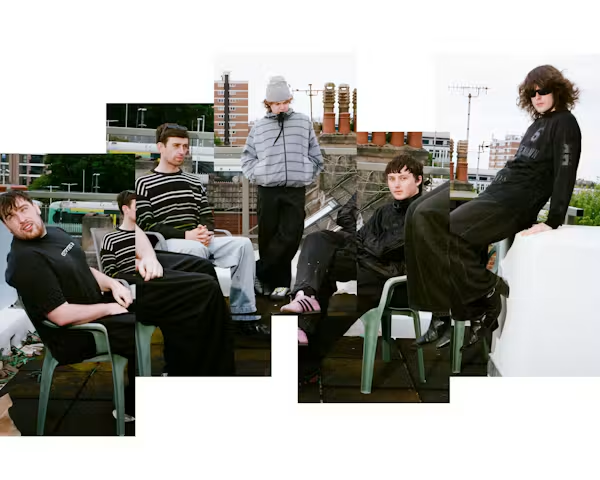
“I started art college in Dublin just as I started in the band. Instead of going to BIMM, NCAD served as much more inspirational.” Inspiration was coming from unexpected places. “Some manifestos and exhibitions would influence writing more than I believe BIMM would. I felt like I had found a secret gem to my approach that I really reaped the benefits from.” The conversation drifts through installation art, Marcel Duchamp, surrealist exhibitions and Brian O’Doherty’s famous White Cube essay.“Learning from this well of inspiration and inspired by endless things like installation art and Marcel Duchamp and the first surrealist exhibitions and even Brian O’Doherty’s essay on the white cube, I have ended up using them to my own advantage.” In some cases, those influences found their way directly into the music
I take some of the lyrics from Brian O Doherty white cube essay and put it in my own context in our song Art.”
What starts as a conversation about artistic influences eventually becomes something much more personal.
“I felt like I was letting go of everything I ever thought to be meaningful in my life. It was like breaking my legs to learn to walk again.” It’s one of those quotes that immediately makes you stop. I was shedding that off, which was painful, but it birthed all these songs and opened the world of the band and art college to me. I felt I had broken through to heaven.”The band and art college seem inseparable in that story. One arrived alongside the other. This was only possible through the tough decisions of being vulnerable and honest.” That honesty appears to sit at the centre of everything Black Nylon do.
When they talk about writing Juliette, they remember working around one of David’s atmospheric guitar ideas. “I remember whispering it across a soft, eerie atmospheric idea that David is so good at on his guitar. It’s like he is painting the clouds to the painting.” The song centred around the name Juliette, somebody from their real lives, and that initially felt uncomfortable. “Because the name does belong to a real person in our life, I was very hesitant about using it.”
A conversation within the band changed that. “Kilian came in the next day and said if your gonna sacrifice your last life and mean what you say go the full way and don’t half mean it.” That advice clearly stayed with them.
“Unlocking this really meant a lot from the start.” When I ask if fans are hearing genuinely personal experiences in the songs, the answer is straightforward. “There actually are many things that have been said in personal life that have been put in the songs. Poems that have been given to people. So I suppose yes, you can glimpse into very private conversations that have happened.”
Particularly, they point towards She’s My Lady. Juliette takes on another meaning entirely. “Juliette surrounds meanings of being silenced. Of being sent to Coventry.” The way they describe it feels almost cinematic.
“As no one could hear the struggle of ostracisation and a side of a story as it has been banned from everyday conversation. Juliette can serve as the final words that no one has heard until it’s too late as he stands on trial on the gallows, or as I imagine the stage while performing.”
The same intensity is present in BDSMX. Interestingly, some of the song’s origins only became clear afterwards. “I realised afterwards where BDSMX came from.” They trace it back to Pixies. “My subconscious had taken in the part of the Pixies song Cactus where there is a notable part of the song where a mantra like depraved whisper spells out the band’s name P-I-X-I-E-S.”
From there, it merged with influences they were already carrying with them. “My own version of this came to fruition, and then I collaged my own play on letters to the PJ Harvey Nick Cave-inspired lyrics I already had.”
The relationship between music and lyrics is something they’ve spent a lot of time thinking about. “The music can influence the lyrics more, I’d say.” At the same time, they don’t believe songs happen without a reason behind them. “I would always write a song or melody out of the need of having something to say. So you could say the music wouldn’t exist without that reasoning, but the music influences what is being said at the same time.”
Ultimately, they return to the same point. “The most important thing about a song is what you have to say.”
For all the discussion around art and songwriting, they’re equally honest about the realities of building a band in 2025. “In the first week of starting the band, I think we wrote more songs than we did have conversations with each other.” Social media came later. “Socials and contacting never became a thing until a few months after the band started, which is a chore that is inevitable.”
Like many emerging artists, they’ve had to learn skills beyond writing songs. “You have to be your own manager until you get one. You have to struggle through a set of waves until you can win yourself a little calmness before the next set comes in again.” Networking isn’t something they naturally enjoy either.
“Networking is something that feels quite unnatural for us, as we’ve become very insular the more we go dive deeper into this.” Instead, they tend to trust things that grow organically. “If a thing is to work well, it may happen naturally and on both sides for us.” That philosophy extends into the wider music industry too.
“If you find the right people who can be ports in the storm, then yes. There are some people you can trust to have good taste and reasoning for which direction they advise to point you in.”
At the same time, they’re careful not to lose themselves in other people’s opinions. “It’s important to be yourself and trust your own judgement too. To work with criticisms or opinions to make up our own mind.”
They’re particularly wary of changing their art simply to please someone else. “Trust your gut as opposed to fully delving into compliments and criticisms to avoid changing who you are and what your art represents to tailor to someone else’s views.”
One experience that clearly left an impression was Left of the Dial. “The biggest thing I took from Left of the Dial was that I felt I was fully submerged in everything I’ve ever wanted for moments of that trip. Every single scene of that trip felt meaningful.” The excitement is still obvious when they talk about it.
“To run around a European city playing many shows and experiencing the love of the local city was like moments of a happy dream.” More importantly, those memories still drive them. “Those moments will be fuel for the reason we travel and do this and will also be ones I will remember in later life, I’m sure.” Even the stressful moments became meaningful afterwards. “Even the feeling of relief from doing a high-pressure first recorded radio show moment felt like finding water in the desert.”
As for success, they don’t seem convinced much has fundamentally changed. “It changed nothing but just made us more proud of each other.” What has changed is their confidence. “Confidence performing grows stronger each day.”
Touring has also revealed something interesting. “It’s also interesting to see how different cities react to different songs, culturally, alternative music is different everywhere, and some songs go down better than others in different cities.”
Looking ahead, they’re already thinking about where the music might take them next. “The one world we’d love to dive deeper into is synthesisers; getting proficient in that language of expression is something that interests us.” Then comes one of my favourite lines from the interview.
“We also had a laptop in the room with us at that time, so we can expect some subtle synth texture and lead lines too. Who would Oasis be if they had a laptop at the time?”
As our conversation comes to a close, I ask what keeps them moving forward when uncertainty inevitably appears. “The truth possibly.” It’s a simple answer, but after everything we’ve discussed, it feels entirely genuine. “Whenever we have a doubt or are tired and see unhelpful thoughts creeping in, we always remind ourselves that the truth will always prosper.”
By this point, we’ve spoken about art college, transformation, vulnerability, private conversations becoming songs and the risks that come with being completely honest through your work. “When all is said and done, we trust people to see what’s true and what falls short of that mark.”
For a band that places such importance on saying exactly what they mean, it’s a fitting place to finish.
“To do this takes more of a risk, and I trust people can smell that as much as they smell fear and appreciate it.”
For all the discussion around genres, labels and influences, that idea probably tells you more about Black Nylon than anything else. Not the sound. Not the scene. Not the momentum behind them. Just a group of people trying to make something truthful and trusting the audience to meet them there.
The band recently supported GANS at London’s iconic 100 Club, and are in their UK tour supporting Cork rockers, Cardinals. Following this, they will join Bleech9:3 on their UK tour as well as supporting the likes of Fat Dog and For Those I Love for their Dublin headlines.
By Eimear Lynch – Photo Credit
About the Author