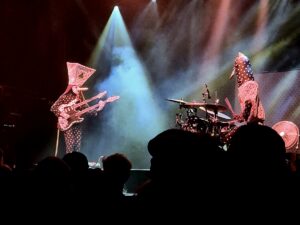
“IT HURTS, BUT I LOVE IT”: RANDY BLYTHE ON 30 YEARS OF LAMB OF GOD AND GOING ‘INTO OBLIVION’ ON NEW RECORD

INTERVIEW | RANDY BLYTHE – LAMB OF GOD by Adam Kennedy
In the world of heavy metal, few voices carry as much grit as Randy Blythe. For three decades, Lamb of God has stood as a pillar of the genre, evolving from the Richmond underground into a global powerhouse without ever losing their sociopolitical edge.
Following a whirlwind year that saw Randy release his second book, Just Beyond the Light, and embark on a spoken word tour, the focus has shifted back to the music. Their highly anticipated new album, Into Oblivion, marks their first full-length release in four years.
From the “parasocial” traps of modern social media to the apocalyptic state of global affairs, Randy remains a sharp-eyed observer of the chaos around him. Ahead of the release of their new album on Friday 13th March, the frontman opens up about the evolution of the new record, the “magic and mystery” of the pre-internet underground, and why the UK remains a spiritual home for the band as they prepare to headline Bloodstock this summer.

Let’s begin by reflecting on the last 12 months. How was last year for yourself and the band?
It was way busier than I expected it to be. In February 2025 my second book, Just Beyond the Light came out and I went out on a two-leg, month long spoken word tour of North America. After that we went straight into writing and then I went to California to record the album. We finished the year in Mexico after a bunch of festivals and gigs.
I felt like it was supposed to be kind of a light year, but it wasn’t at. I did some guest vocals with other bands as well, including Lacuna Coil. So, it was busy as always.
You’re about to release your new album Into Oblivion and it’s the first full length release in four years for Lamb of God. How are you feeling ahead of the album release?
I feel pretty good about it. I mean, I try not to have really preconceived notions of how something’s going to go. You know, how it will be accepted in that particular moment, because sometimes records come out and they don’t immediately connect with people, and then later they do. But overall, I feel good about it.
I think with this record we had some more time in between it and the previous record. Our self titled Lamb of God was supposed to come out in April 2020, but COVID happened, so we kept delaying it but eventually, we were like, we can’t delay this anymore and it was released by June.
It was very strange to make a record and not tour it, because that’s been the entirety of my adult life basically – write, record, tour. But nobody was touring, and our record label was like, well, we’ll take another record. So, we immediately wrote another record – Omens (2022) – and to me, it felt rushed. I understand why we did it, because my guys have kids and they’re expensive and nobody’s making any money not touring. But with this one, there’s been more time in between and I like it better than the last one.
In terms of the title Into Oblivion, were there things that you wanted to get off your chest to write about the political and cultural events that are happening in the world presently today?
Well, that’s what I get off my chest with every single record. I’ve been doing this for 30 years. And from the very first song I ever wrote for this band, it was sociopolitical commentary. We’re not a smooth R&B band. We don’t write love songs, you know? And as the late great Nina Simone said, it’s the duty of the artist to reflect the times. I think this record does.
Interestingly enough though, I wrote most of the lyrics on the record but my guitar player, Mark (Morton), he writes lyrics sometimes, sometimes we co-write. He started the song ‘Into Oblivion’ and that song, originally, from what I understand from him, from his initial verse and chorus, was much more an internal-looking song. It was much more looking at the inner psychological battles that we all fight in one way or the other, not so much external chaos. When I got the song, I definitely turned it more towards that.
So, the song kind of has two meanings. He’s the one who suggested it as the title track, and we thought, well, it just fits. But I don’t think when he started writing the song, he was thinking about the apocalyptic world we live in, you know?

As one of the bigger metal bands in the world, how does it feel kind of looking back on that period of the band’s career and what do you recollect about those early days coming through as a band in the underground scene?
I don’t want to be the old man shaking your fist at the sky and saying how much better things were back in the day, because it doesn’t really matter, we’re here now. You have to make the most it. But I’m grateful we did.
We got to become a band and learn how to be a band and write our songs back when the regional music scene still existed. I feel that with the advent of the internet and everything being available to anyone, anywhere, all the time, the regional scene is kind of dead. It doesn’t really exist anymore, at least not in rock so much.
When I came up in the 1980s and into the 1990s, there were very distinctive regional sounds, at least here in America, within the sort of underground punk, hardcore and metal scenes. They all sort of stewed in their own creative juices and learned from each other and developed this sort of regional identity. Richmond definitely had its own regional identity, which has informed us.
I also feel lucky to have experienced discovering music at a time when to find new music, you had to go to the record store, or someone had to tell you about it. Even finding out about shows, there was no internet. You had to go to the record store and look in the window and see a flyer and you’d think who is that? Maybe you recognised one band, but you went there, and you got to hear whoever else was playing and you couldn’t go on your phone and be like, what do these guys sound like? Do I want to go give them a chance? You just had to go and pay your $5 and sometimes it was magic. Sometimes it wasn’t, but there was a mystery to it and an excitement to it that I think is absent in today’s world.
Did you ever think at that point in time, as a band coming out of the underground scene, that you could see the trajectory, the path?
Absolutely not. Are you crazy? No way. When we formed the band, our original name was Burn the Priest – that’s not what you’re thinking with that band vane. All of those things have happened to us, but it was never, ever a thought in my mind. I never thought we’d ever be able to make a living doing this stuff. It’s just something we enjoy doing. You make music because it’s in you.
You said how you like this new album more than the previous record. How do you feel it sits within the context of the whole Lamb of God catalogue?
I don’t know yet. That’s impossible to know. It’s not out yet. We haven’t pressure tested the songs live yet. One of the most exciting things for me about releasing a record is going out on tour and seeing what songs are going to connect with an audience. But right now, I don’t have a crystal ball. I don’t know how it’s going to connect. I know personally that I like it better than the last one.
The track ‘Parasocial Christ’ has been described as a three-minute onslaught. Can you tell us a little bit about that song and the inspiration behind it?
I came from that time where they were going to make TikTok illegal in the USA at one point. Do you remember that? People lost their mind.People who were like; ‘I’ve built my whole career around this; this is my way of expressing myself. How can you do this to me?’ And I was looking at this, and I thought, how ridiculous. How ridiculous that you have put all your eggs in this basket. This is your sole means of making money, of artistic expression, of communication, and such a huge part of your identity. You’ve placed all this within the control of a Chinese-owned corporation, that you have no stake in whatsoever.
And in thinking about that, it led me to start thinking about how much attention people pay to other people’s lives online. Think of somebody like the Kardashians. Why are they famous? Why does anybody care what they do? They are rich people who created this weird attention economy around them, and they’re just one example. It seems foolish to me to pay that much attention to someone that you’ll never meet who doesn’t know that you exist at all.
That’s what inspired that song. It was this odd surrendering of time to something utterly pointless, in my opinion. Time is really the only thing we have, and it’s in a finite supply.

After the album release, you’re going on tour in North America, how much are you looking forward to touring with this record?
It’s interesting, as I get older, before the time comes to tour, I’m just like, oh my God. Because it hurts, you know? I just turned 55 and I’m a pretty aggressive frontman. But once I’m out on stage, once we’re out on tour and the machine has started, I really enjoy it. And that’s really the coolest thing. For me though, the thing about releasing records is the pressure testing of the songs in front of an audience and seeing what will connect. So, I have no idea of how the record is going to be taken, really, until I go out and play the songs. I think that’s the proving ground, I think that’s where it matters. You know, can this translate live?
From a UK point of view, you’re going to be coming over here to headline Bloodstock, which is obviously one of the biggest metal festivals in the UK. How much are you looking forward to Bloodstock?
Bloodstock, it’s going to be great. The last time we played was amazing because I got to watch Killing Joke. They played that day, and I got to stand right there, on stage right by Geordie (Walker) and just watch him make that insane sound with his guitar. It was just lovely. It’s a big festival, but it feels really independent. And it’s run by people who just love that particular genre of music. So, it’s going to be a good time.
And how important is the UK market to Lamb of God?
The UK is really important to us. We’ve done extremely well right there from the beginning. The first time we ever played the UK, we got asked to open up for Slayer, two shows at London Astoria. And people actually knew the words and stuff. We were kind of freaked out. We were like, whoa, they actually know about us all the way over here. And they were big shows, sold-out shows. Slayer did Reign in Blood in its entirety. And then we stayed and played three more shows, Nottingham, Oxford and Leeds, I think, playing in pubs. And of course, 50 people showed up. So, we realised, OK, we’re not huge. They were just there for Slayer.
But knowing that people actually knew of us was a big deal. So yeah, the UK has always been great to us, just a lovely, lovely place
How the rest of 2026 looks for the band? Have you kind of got the year mapped out?
Yeah. Let’s see, the record comes out. We tour the States. We play some festivals. Then we go to the UK to do festivals, some more festivals in the US. Then we have a cruise we do every year, Headbangers Boat. And I think there’s one other thing thrown in there that’s not announced yet. Hopefully that’ll get announced soon, but it’s going to be a busy year all the way to the end of 2026.
(Interview edited by Anne Kelly for Northern Exposure)
Into Oblivion by Lamb of God is set for release on Friday 13th March – order here now.
You can see the band exclusively headline at Bloodstock Festival on 7th August – tickets are on sale now.