ORLÁITH FORSYTHE OF DEA MATRONA CHATS NEW ALBUM, SONGWRITING, TOURING, AND MORE

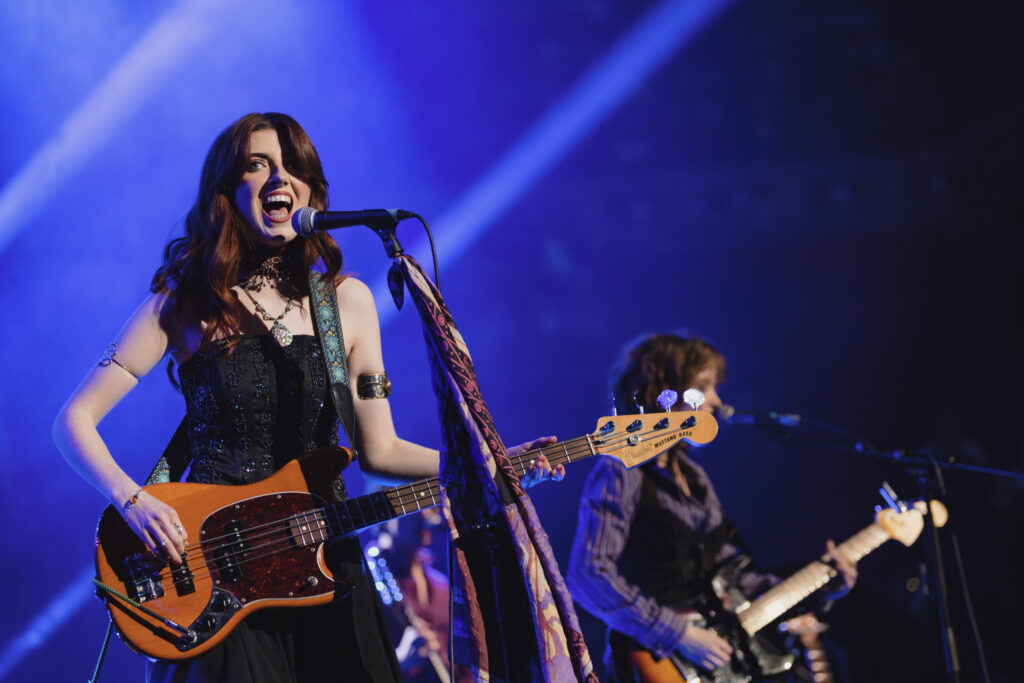
Dea Matrona (Credit: Jane Donnelly)
INTERVIEW | ORLÁITH FORSYTHE by Morris Shamah
Dea Matrona formed in 2018 in Belfast, Northern Ireland, by school friends Orláith Forsythe and Mollie McGinn. Since then they’ve self-released (and self-produced!) their debut record For Your Sins and toured incessantly, often supporting bands such as The Corrs, The Beaches, Sting, and The Darkness. We caught up with Orláith to discuss their upcoming second album, Hate That I Care, out 5th June from AWAL, as well as their upcoming appearance at Sound City in Liverpool.

This your first album with a label, is that right? Your second album, but first with a label.
Yeah, our first album, we released it ourselves independently, and this time, we are releasing it with AWAL. So we’re very excited about it. We’ve just loved working with the team there and everything. I can’t wait for it to be out because I think this album is very much just – us. I don’t know how to explain it any other way. It’s just really a combination of all the years of song writing and, you know, trial and error.
I think it’s just really come to a nice place. And Hate Like I Care, the first single, I really love that song. I just love Mollie’s vocal and I think that’s my favourite thing about it. It’s just like this real side of Mollie’s vocal that I don’t think a lot of people have heard. It’s just very, maybe, vulnerable, but also really fierce. And it just really makes the song for me, I think.
How do you think about, you know, who’s going to play guitar, who’s going to sing, who’s going to play bass?
In terms of the vocal side of it, I think it’s always pretty obvious whose song it is. Even if one of us has written more of it, it’s always very clear to us, like some sort of unspoken thing, who is going to sing this song. But in terms of the instrument, that usually comes down to how easy is it to sing and play the instrument. So I mean, Magic Spell is one of the songs that we released last October and I sing it, but the bass line is, it’s a little bit of a demanding part. So I’ve just kind of shipped the bass line off to Declan, who plays with us live. So I just sing that without an instrument, because it’s easier.
In the studio, do you and Molly have specific instrumental roles?
We switch it about. We’re not really fussy about who plays what instrument on studio things. If something needs recorded, we’ll just do it. But because we produce our music ourselves, we can spend a lot of time on something that maybe you wouldn’t spend on if you were with another producer. That’s the thing about producing your own music. It’s great, but you can definitely like sit on something for a lot longer than you should because you’re doing it yourself, you know?
Doing it yourselves versus doing it for a label, are there additional inputs and pressures coming from the label or does it give you more focus? Is there a difference there?
AWAL have been really, really supportive of what we want to do, which is great. And that was a big reason for wanting to work together. Just like they’ve been really, accommodating when it comes to listening to what we want to do. And we said, we produce our own music and everything, and they’ve really respected that and encouraged it as well, which is really nice for us as producers and songwriters.
Was there a moment in time where you sat down and said, OK, this is what we want the second album to sound like? This is what we want the growth to look like?
We had a conversation about that at the beginning. Mollie and I sat down like, right, what do we want this album to sound like? But I think as it went on, it became clear what it was going to sound like. And in a way, it’s kind of guided us in terms of the songwriting. But I think we don’t like to put a lot of pressure on ourselves when it comes to writing for an album because personally, if I’m told to do something, I’m not really going to do it very well versus just being let loose. So I think it naturally came to the place of where it is now, where it just kind of, that was the vibe of the album, that’s the songs we were writing, which will become clear when the album is out. I can’t give away too much.

Are you writing on tour, are you going into a studio, locking yourself in a room? How do the songs come about?
I mean, it’s quite different every time. Sometimes it would be both of us sitting in a room together and just writing from scratch, or sometimes one of us has a verse idea that we bring to the other person and then we flesh it out and work on it together. Or sometimes it’s just an instrumental that we’ve written and then we’ll just write lyrics over it. So I think that’s the nice thing that we don’t really have this set method that it has to be the same every time, which, you know, keeps you on your toes a little bit and keeps it fresh, which is nice.
It sounds very collaborative between the two of you.
At the end of the day, it’s quite collaborative because we’re always going to finish the songs together. We do work as a team, maybe that’s the most important thing to say. It’s always me and Mollie just finishing ideas or constructing them.
Do you write with the live show in mind?
No, I don’t. When we started, I used to try and think about that and I think it maybe distracted me a bit too much. But that’s the fun thing, when you write a song, you’re not thinking about how to do it live. So when you go to think about doing it live, you have to change things or change certain parts of the instrumental and everything, which is quite fun.
Was there a specific song that surprised you when you came to arranging it for the live show?
Yeah, I think maybe Magic Spell. was a little bit more difficult because I didn’t realize that I wouldn’t be actually playing an instrument. That’s the only song we’ve ever done where I don’t play any instrument on stage, which is a little bit scary sometimes because I don’t know what to do with my hands. I have a scarf on my mic stand that I sometimes kind of use.
I thought Hate That I Care would be a bit more difficult to play live and arrange for live, but actually it came together really nice. And I think after My Own Party, it’s my favourite song to play in the set now, just ’cause it’s so, I don’t know, it’s just really a nice song to play. Cathartic as well.
How do you go about writing a setlist?
Yeah, I think the more gigs that we’ve done, we are a little bit more particular about it because, you know, there’s a lot of things to factor in. You don’t want to kind of open too strong or too soft or, you know, it has to be right. But I think we’ve got a good one down at the minute. And also because Mollie and I, we switch vocals and instruments and everything, we have to be conscious of like, I don’t want to sing like 6 songs in a row- for the voice, and for the audience, who just don’t want to see me sing 6 songs in a row. And I’m sure Mollie feels the same. But no, it’s a process that we just sit down together and kind of think about what’s worked before and what hasn’t, you know?
Is it something that changes show to show or is it that you kind of get a setlist going and you ride that for a little while?
We do change it sometimes. Maybe we’ll take a song out, put one in, take a song, put one in type of thing. But personally, I kind of like when you get into that routine of not having to even look at the setlist and everything becomes very like, oh, I can just do the show without thinking and, not be stressing about looking at the setlist. But we do change it, especially if we’re going between support shows and headline shows. You obviously have 30 minutes on a support show, so a lot of songs have to come out versus the headline shows.
Is it tough to make those calls about which songs come down? How do you make those decisions?
It can be, yeah. Just because it’s 30 minutes, it’s quite hard to squeeze everything in that you want an audience to hear, you know? I think in terms of a support show, we just kind of think of what would a new audience want to see. I mean, you don’t really want too many slow songs, or you don’t want too much too soon type of thing. So I always just try to think of it, you know, if I was in the audience watching a support band, what would I like to see? And, especially, interactive songs where you can kind of get the audience going and everything is quite a good idea, I think.

You’ve been opening for some really impressive bands. Is there anything in particular that you learned from opening for these sort of bands?
Yeah, definitely. I think the coolest thing about touring with so many artists, like you’ve just mentioned, is you always do learn something. And no artist is really ever the same. But I feel like The Corrs were so lovely to us and so nice. And I watched them every night when we toured with them in Germany. I would just go and watch their set. And just the way they would command the audience and everything was just so nice. And the same with The Beaches. You just, you take away so much when you’re able to just watch these artists and see how they, work with their audience and everything. It’s really inspiring for us.
And you just wrapped up a headline tour, is that right?
We did, yeah. We were in Europe, our first ever European headline tour. So it was really fun. And that was like our first shows like of our own and everything. So we went from, Spain, Portugal, France, Germany, Scandinavia. So we had a really good time.
Did you find that having opened for these bands that those headline shows, you were able to bring some of that experience to them?
Yeah, definitely. I mean, it’s great practice. I think that’s the thing about support shows. Like, it’s harder in a way because it’s an audience that don’t know who you are and they’re not there to see you really. So you kind of have to put a little bit more work in to get their interest as well and keep them entertained because you’re ultimately opening up the show. So you have to do a job to entertain them as well. But no, from all the support shows we’ve done, we’ve met a lot of really really nice people that have came back to our gigs as well, which is really, really sweet.
And in these headline shows, you’ve been playing some of the new album. Presumably, the audience hasn’t heard those songs before. How has that been going?
Yeah, I mean, it’s always a little bit daunting when you’re playing new songs. And we did a few songs from the album that aren’t released. They went on really well. We were in Scandinavia and we played a show in Copenhagen. I saw there was a guy at the front row and he knew all the words to My Own Party. I was like, this is not released! And then he came to the show in Stockholm and he was singing it again. I said to him, I was like, how do you, how do you know the words? It’s dedication. So somebody knows the words out there in Scandinavia to the unreleased songs, which was really cute.
Are there any bands that you’ve looked at and said, that’s kind of the kind of live show we want to emulate?
I think when we watched The Beaches, they were doing a little bit of instrument switching. I mean, they’re, most of them are multi-instrumentalists, so I really loved how they were going between instruments. And I mean, in terms of like switching the singers, Fleetwood Mark have always been quite an inspiration in that regard as well. Like going from Stevie Nicks to Christie McVee, Lindsey Buckingham, just nice to kind of keep it fresh that way with a different vocalist too.
Yeah. You’ve been playing, was it Oh Well that you’ve been playing?
Yes, we always play (Fleetwood Mac’s) Oh Well because when we started busking that was one of the first songs we ever did and we used to play it all the time. So we like to put that in the set because it’s kind of like that little moment of, oh, we used to play this on the streets and here we are playing it wherever the venue is, you know, so it’s quite nice.
And there are a couple of other covers as well. How do you sort of choose to give up a slot of an original for a cover or vice versa?
I think as somebody who goes to gigs, I like it when bands throw in a cover, just because it’s fun to see what they’re going to do with it and also fun to see how the audience is going to react to a song. And on this tour, we did Love Buzz – it’s originally by Shocking Blue, but we were kind of going from the Nirvana cover. We just really liked it. was quite experimental , you can have a bit more fun with the instrumental side of it. Molly was on the slide guitar and everything. So it was quite a fun one just to throw in. And in terms of other covers that we’ve done, we used to do them just because we liked the song and we just really wanted to play it. Like our early stuff was throwing in a lot of like Led Zeppelin because we wanted to just rip the solos, basically.
You’ve been an opener, you’ve been a headliner, you’ve been a festival act. These are really different stages and crowds and rooms. How do you stay consistent across these very different types of shows?
That’s a good question. I think for us, we always just want to give it our best no matter what we’re doing. I mean, I’ve always said just treat it kind of like it’s Glastonbury wherever we play. And that model has kind of taken us from when we used to busk, we would just busk like it was a gig. It didn’t matter what we were doing. Any stage, we would just play like we were basically playing in a festival. And that’s kind of always been our approach just Just give it your best and enjoy it as well.
Are there any festivals this summer that you’re particularly excited for?
Yeah, there’s quite a few. I mean, I’m very excited for Sound City, number one, because I love Liverpool. And I’ve heard great things about it. So I think that’s going to be really fun. The Great Escape as well, it’s always really cool. And we’re doing a few other ones as well, Kendall Calling and Why Not Festival. I haven’t been to either of them. So I think they’ll be quite fun as well.

Dea Matrona’s new album ‘Hate That I Care‘ is out on 5 June from AWAL. You can pre-order it here.
Dea Matrona is playing Sound City Liverpool on May Bank Holiday Weekend. Tickets are available here.
You can see Dea Matrona’s other summer dates on their website.