TURN AROUND, DISABLED FANS DESERVE TO BE SEEN

Rock concert photographs serve as proof that you attended a show and that the evening held significance. More importantly, they capture the shared euphoria that connects audience members. A photograph of the crowd becomes a record of this collective experience, showing arms raised, sweat dripping, and people united in a shared passion.
But notice. Where are the wheelchairs? Where are the fans who have to sit in order not to collapse from standing? And where are the concert-goers who paid the same amount of money, who experienced the same bass thunder, but who fought battles against their own bodies or brains to get into the concert venue?
They appear sometimes, but more infrequently in photographs. Unless you are headbanging in the pit or pushing up against the barrier, the camera lens speeds by. And when it swings away, something from the history of the night disappears.
It was at a Kneecap gig that I found the disabled viewing area, not out of need but due to suffocation brought about by anxiety, suffocating me long before any music had even been played. It was quite ironic, but entirely fitting that I found solace in an area where wheelchairs or impaired mobility are needed, because people such as these are always absent since they do not represent the “ideal” concert-goer. It was paradise in seclusion.
I struck up a conversation with the people around me, some in wheelchairs with loved ones, some wearing noise-cancelling headphones, some sitting because, quite simply, they couldn’t stand. Each had hurdled different obstacles to get there, but we all harboured the same stifled passion. Meanwhile, snappers moved through the crowd in search of the “perfect” crowd photo, a photo in which actual passion can be found only in standing, screaming masses.
I got talking to a disabled guy and his girlfriend, two of the warmest, funniest, most passionate Kneecap and music fans I’ve met in years. We had a proper chat about gigs, access, and how wild it is that we all ended up on the same little island in the room. I said we’d do a full interview for Northern Exposure, but in the madness of the night, I completely forgot to take their names or details. If you two are reading this (you’ll know who you are), please get in touch on our Instagram or contact page. I owe you a proper piece.
And honestly? I’ve been just as guilty as every other photographer. For years, I’ve chased the same standing, sweating, arms-aloft shots and barely glanced at the platform. This night cracked something open in me. I saw the room differently, saw the people differently, and I’m not letting myself off the hook anymore. Turning around starts with me.
In the UK, where approximately 20% of the population is disabled, live music events represent a vital cultural outlet, yet systemic barriers persist that exclude many from full participation. According to Attitude is Everything’s 2018 State of Access Report, a staggering 82% of deaf and disabled music fans encountered difficulties booking tickets for concerts and festivals, with 73% reporting feelings of discrimination due to inadequate access information on venue websites, information essential for determining attendance feasibility. This issue compounds broader attendance challenges: a 2024 Transreport survey of 1,000 disabled individuals found that 52% avoid gigs altogether owing to venue inaccessibility, while over two-thirds (70%) described concert spaces as “ill-equipped” for their needs. Despite some progress, such as a 70% rise in disabled-access ticket sales at gigs and festivals reported in 2015 by the same charity, and a 111% increase in disabled attendees at events like Reading Festival, exclusion in concert photography remains under-quantified but anecdotal evidence suggests it’s rampant, with photographers rarely capturing accessible areas, effectively erasing disabled fans from the visual record. These statistics, drawn from sources like Attitude is Everything’s ongoing reports (including the 2016 edition based on 280 mystery shopper audits) and UK Music’s diversity insights, underscore the economic toll: the industry could be forfeiting millions in revenue from an audience comprising 11% of live music attendees, highlighting the urgent need for comprehensive reforms in ticketing, venue design, and media representation.
A great example of inclusion in action would be the collection of photographs taken by photographer Brittany Long, featured in VICE, who happens to be in a wheelchair herself, titled Stairing Through the Lens. Through her photographs of musicians sitting or standing on staircases, she represents inaccessibility and raises issues such as inappropriately positioned accessible seating in venues, usually at the back or in the upper sections, and the need for venues to offer clear accessibility information and involve members of the disabled population. Her photographs relate to the need for all photographers to “turn around” and ensure they photograph the whole audience, including members of the disabled population.
Recently, disabled reviewer and photographer at Concert Chronicles, Natalie Ovenden, has posted her review about Kneecap after their concert performance. Kneecap had truly gone out of their way to make Natalie feel included not only in terms of reviewing but in taking pictures as well. Click here to check out her review. On the other hand, the reserved accessible seating was occupied by loyal fans, showing dedication to active inclusion. It was a pleasure to meet and welcome Natalie to our Northern Exposure family and help her build her portfolio.

Artists and musicians need to listen up because they could make a huge difference in the world with just one small action, like including disabled people in the distribution of setlists. They already throw them out to the people who are at the edge of the barrier, so why not to the platforms too? For autistic or anxiety-suffering concert-goers, having something physical to take back after the experience gives them security and makes them feel like they belong.
Photographers, your task is every bit as critical and equally simple. Turn around. Take one photo of the stage, the people seated in the stands and the fan covering their ears in time to the music. One photo that says, “This moment was ours too.” If you want to ask permission to take photos, go ahead and ask.
Being absent from such visibility cuts deep, suggesting they’ve never been there in the first place, that disabled people’s joy isn’t worth being remembered. In concert memories represented solely by images of thronging masses in struggle and song, our erasure rewrites history to remove those who aren’t always visible, who benefit from such a platform, who are every bit as much in love with the music as anyone. But we were there. We fought hard to make it there. We deserve to be acknowledged. Artists, share your song list. Photographers, take photos of the audience.
Words Rachel Brown
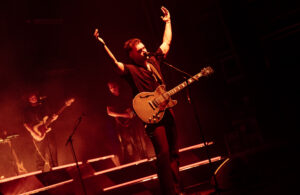
Photo taken by Nats Camera