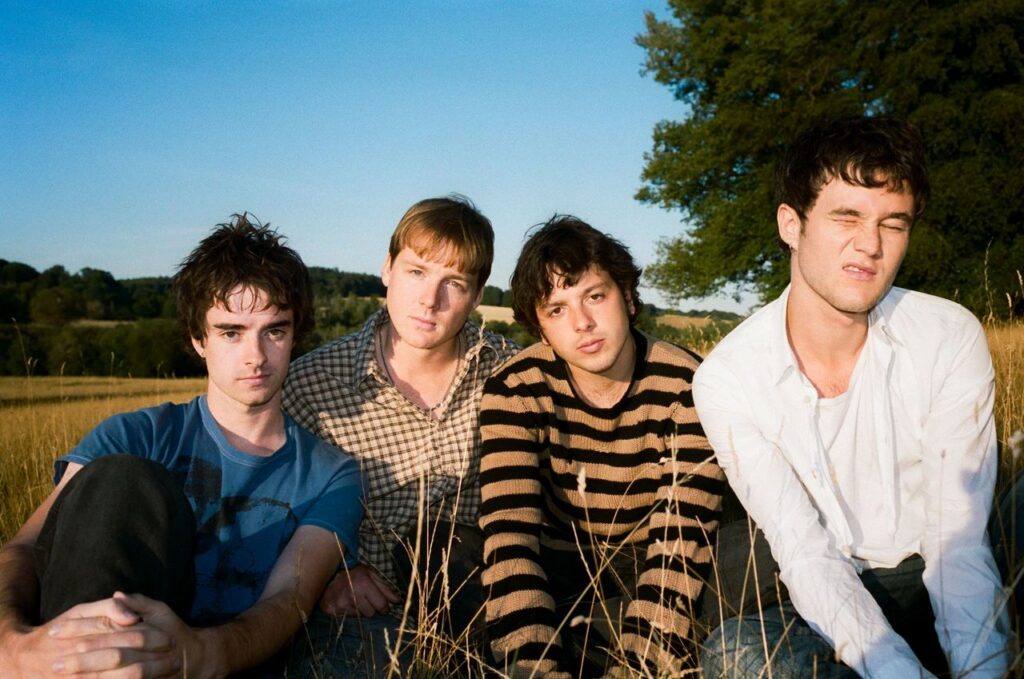
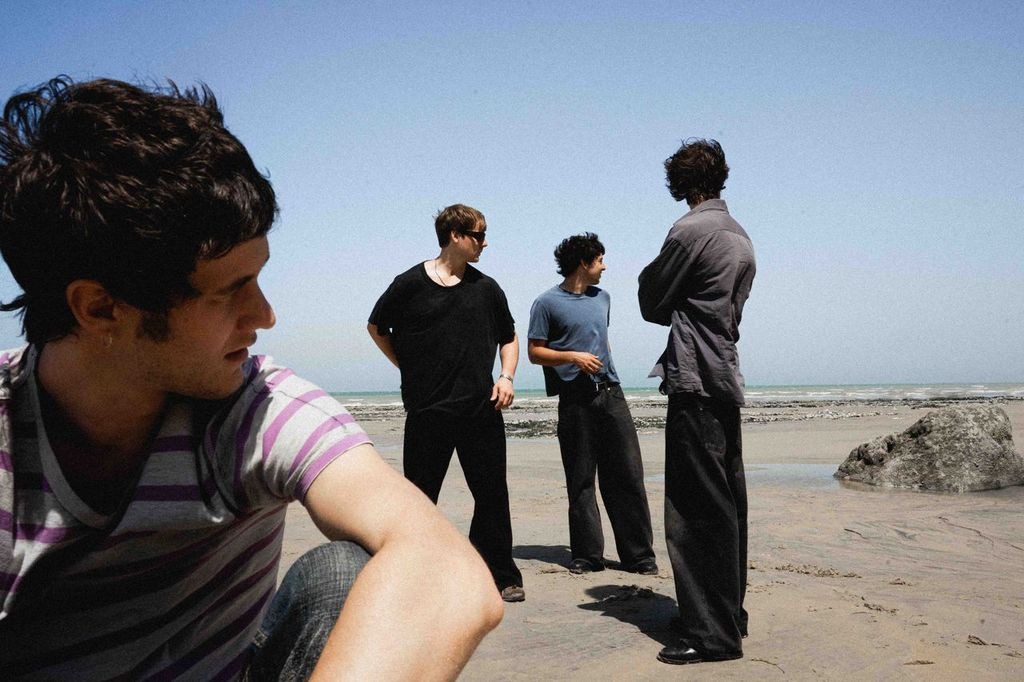
With Radio Free Alice’s debut album What’s In Between due for release on 30 October, lead singer Noah didn’t sound nervous. If anything, he sounded relieved. “I’m really proud of this album,” he says. “I suspect a lot of bands promote records they’re not actually that proud of, but I can say confidently that I am. If I wasn’t literally one of the people in the band, I’d really like this album.” That confidence wasn’t arrived at easily, he tells me. What’s In Between needed so much discussion on order, inclusion, intention, ensuring each song had a purpose because otherwise it wouldn’t work.
“We wanted each song to occupy a different space on the album,” he explains. “We didn’t want multiple songs doing exactly the same thing. There was a point where we realised we had too many melodic ballads and had to decide which ones were the strongest. We were like, “Shit, okay, we’ve got to pick the best song from the melodic-ballad category.” Some disagreements were unavoidable, as with anything, but nothing serious, he assures me. “We’d just vote. If something didn’t make the record, we’d save it for another time. Maybe another album.”
When asked about the meaning of the album in 2026, Noah pauses for a moment. I notice he does this a lot throughout the interview, and I always see it as a good sign that someone is really thinking about what they want to say.
“I don’t know if we’re trying to say anything political. There’s definitely an emotion we’re trying to convey, but if I could explain it properly in words, we probably wouldn’t have written the album. It sounds corny, but we just wanted to make something beautiful.”
RFA Press
That pursuit of beauty arrived alongside a different challenge, which hits any upcoming band, manoeuvring the realities of a growing career. The band has existed in one form or another for almost a decade. While the current incarnation of Radio Free Alice is far younger, Noah traces its roots back to a teenage project he started with bandmate Jules. “There have been different names and different members, but to me it’s always felt like the same band. In the early days, we were just trying to write a banger. Now we’re trying to find something a little more complex.”
As attention grows, it often brings along a weight of pressure that can feel overwhelming. Noah thinks a lot about what success does to people, particularly those who feel the weight of other people’s expectations more than most. “This is the first time we’ve had this many cooks in the kitchen,” he says. “A lot of people are invested in what we’re doing now. It’s not just us anymore.” Rather than shrinking under that pressure, he believes the band responds well to it. “I think some people work better under pressure. I know I do.” What he finds more difficult is public perception.
“When you’re in a band that has any sort of profile, everyone’s got an opinion on you. Some people think we’re great. Some people think we’re overrated. There are people who think we’re great and people who think we’re overrated and that we’re, you know, a Temu Interpol or whatever.Sometimes that’s fine. Other times it’s a lot.”
It led him to an observation about musicians and ego that was one of the most interesting moments of our conversation. “I was thinking recently about why successful musicians often end up with huge egos. Part of it is the adulation of playing live, but I think it’s also because having thousands of people form opinions about you is unnatural. If you’re a sensitive person, and most musicians are, it can be really difficult. To survive that, you almost have to develop this mentality of, ‘Well, my opinion is the only one that matters.’ It’s survival, a defence mechanism. The problem is that’s also quite an egotistical way of thinking.”
The same logic explains why Radio Free Alice largely stopped reading reviews from magazines and journalists.
“If you’re a sensitive person, and most musicians are, it’s difficult to deal with a lot of people having opinions about you and your music. To deal with that, you have to insulate yourself a little bit by developing this mentality of, ‘fuck everyone, my opinion’s the only one that matters’.”
What I find really interesting is that Noah believes positive reviews can be just as damaging as negative ones. I ask him what he thinks of music journalism. “In the early days we’d read everything. Now we don’t. A glowing review might celebrate one particular aspect of your music, and suddenly you’re thinking, ‘Should we do more of that?’ But that’s not necessarily helpful. I don’t think artists need feedback from hundreds of people. You need two or three people whose judgement you trust.”
As Noah talks about discovering an old NME review of a David Bowie album from the late seventies, the conversation drifts naturally towards the state of modern music journalism. What struck him wasn’t whether the writer liked the album; it was the absence of comparisons. The review examined emotion rather than influence. Listening to him, I was reminded of my own recent review of Fontaines D.C.’sDopamine Chamber. Rather than listing sonic reference points or tracing musical family trees, I’d deliberately written about what the record actually felt like. Noah immediately understood the point.“That’s exactly the style of reviewing I don’t see much anymore,” he says.
It’s perhaps unsurprising that a band often compared to artists such as The Smiths, The Cure, Interpol and Fontaines D.C. thinks carefully about outside influence. Noah isn’t offended by the comparisons.
“I’m flattered by them, honestly. Those bands are the reason I fell in love with music.”
But he contemplates whether the constant comparisons sometimes became limiting.
“We never started with a mission statement about sounding like those bands. We just naturally did. Then people started describing us as combinations of various post-punk and indie bands, and maybe subconsciously we leaned into that more because that’s what everyone was saying.”
The conversation soon broadens from Radio Free Alice’s own experiences to the weight of expectation hanging over indie rock as a whole.
“I feel like we live in a time where, particularly in indie rock, there’s so much history attached to the genre. There’s this weight hanging over everything. You’ve got these legendary bands, these giants, shining down from above. And it’s hard because there have been such geniuses in the genre. It’s difficult to escape those comparisons. I don’t know if other genres are quite as comparative. Maybe they are.”
Hannah Jane Murrell
As our discussion shifts to the UK, where the band have a huge tour lined up, Noah acknowledges bands like Fontaines D.C., Wunderhorse, and other contemporary guitar acts for helping Radio Free Alice gain a following overseas.
“We’ve probably picked up a lot of fans through those scenes. Sometimes I joke that we’ve got our whole career to thank Fontaines D.C. for. UK crowds are very boisterous. It almost feels a bit like an Oasis crowd sometimes. It’s really fun.”
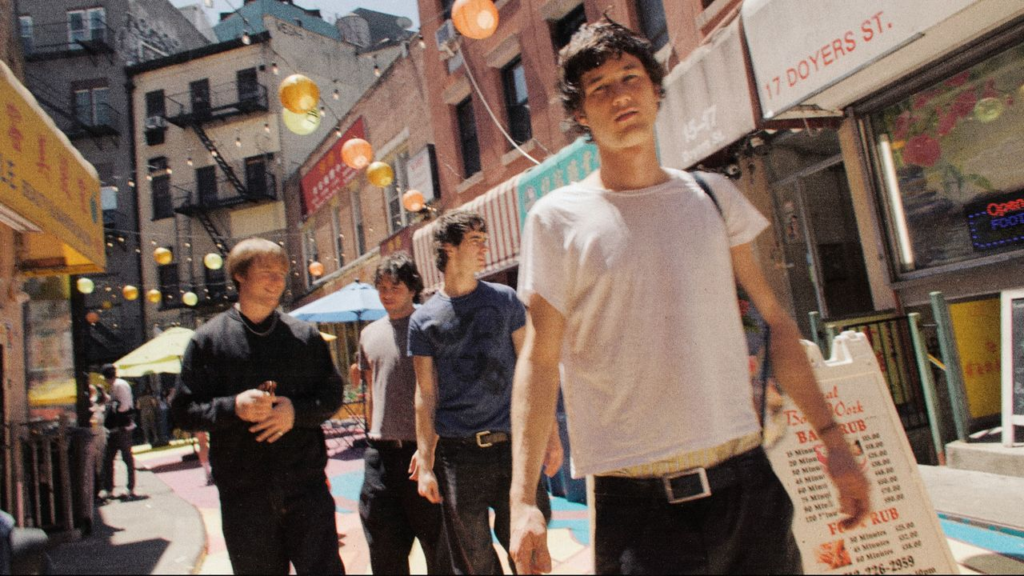
Touring internationally remains both a privilege and an endurance test. “It’s a unique type of exhaustion,” he says. “You don’t sleep enough, you’re playing every night, and you want to give people their money’s worth, but you’re exhausted.” At the time of our chat, the band were battling jet lag in New York. Having interviewed many touring bands, I am aware it’s not as glamorous as people like to make out. Noah agrees, “I went to bed at nine o’clock and woke up just before midnight. Then I was staring at the ceiling for the rest of the night. It’s tough.”
Outside music, Noah’s main obsession is film. His list of favourite directors includes Lars von Trier, Mike Mills, Michael Haneke, Gaspar Noé and Todd Solondz. The diversity of influences is striking. Best film? “My favourite film of all time is Happiness by Todd Solondz.”
When it comes to the album itself, two songs stand out.
“Undressed is probably my favourite. When we play it live, I feel really proud of it. Then there’s What’s In Between. I think that’s a really well-written song.”
As for the band’s long-term ambitions, Noah laughs before answering. “I got asked this recently, and when I read it back I thought I sounded like Liam Gallagher,” I said, that’s okay, but please don’t say biblical. We laugh as he pauses for a second,
“We want to make really good music. When we’re fifty or eighty years old, I’d like us to look back and be genuinely proud of what we made. Obviously we’d like to be successful commercially too, but only if we’re still making music that’s honest and true to who we are.”
Before signing off, he takes a moment to praise fellow UK indie outfit Lime Garden.“I think they’re brilliant. They’re highly rated already, but honestly I think they should be massive.”
It’s a fitting way to end a conversation that repeatedly returned to authenticity. For all the talk of success, streaming numbers, reviews and expectations, Noah seems most interested in something much simpler, getting excited about great music, whether it’s his own band or someone else’s, and making work he can genuinely be proud of.
If What’s In Between achieves that, Radio Free Alice may already have succeeded.
With What’s In Between arriving on 30 October and a major UK tour on the horizon, Radio Free Alice look poised for their biggest chapter yet.
Used by Google Analytics to determine which links on a page are being clicked
30 seconds
_ga_
ID used to identify users
2 years
_gid
ID used to identify users for 24 hours after last activity
24 hours
_gat
Used to monitor number of Google Analytics server requests when using Google Tag Manager
1 minute
__utma
ID used to identify users and sessions
2 years after last activity
__utmt
Used to monitor number of Google Analytics server requests
10 minutes
__utmb
Used to distinguish new sessions and visits. This cookie is set when the GA.js javascript library is loaded and there is no existing __utmb cookie. The cookie is updated every time data is sent to the Google Analytics server.
30 minutes after last activity
__utmc
Used only with old Urchin versions of Google Analytics and not with GA.js. Was used to distinguish between new sessions and visits at the end of a session.
End of session (browser)
__utmz
Contains information about the traffic source or campaign that directed user to the website. The cookie is set when the GA.js javascript is loaded and updated when data is sent to the Google Anaytics server
6 months after last activity
__utmv
Contains custom information set by the web developer via the _setCustomVar method in Google Analytics. This cookie is updated every time new data is sent to the Google Analytics server.
2 years after last activity
__utmx
Used to determine whether a user is included in an A / B or Multivariate test.
18 months
_gac_
Contains information related to marketing campaigns of the user. These are shared with Google AdWords / Google Ads when the Google Ads and Google Analytics accounts are linked together.