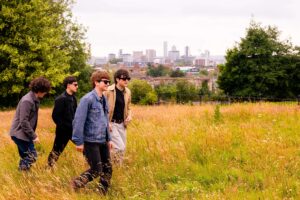
“LISTEN TO US. ASK US.” GLASGOW’S WATTERS CHATS NEURODIVERSITY, INDUSTRY BARRIERS AND THE UNIQUE SOUND OF ‘ALEXITHYMIA’

INTERVIEW | WATTERS by Anne Kelly
Securing funding from Creative Scotland is a milestone in any artist’s career, but for Glasgow-based artist Watters, it represents something deeper: a chance to bridge the gap between internal experience and external expression. His upcoming project, ALEXITHYMIA, isn’t just a collection of songs; it’s a vital exploration of neurodiversity and the barriers—both personal and systemic—that come with it.
Fresh off his funding success and ahead of his EP launch show at The Hug and Pint, I spoke with the man behind Watters – Jacob – to discuss the journey of finding his voice, the hurdles of the ‘accessible’ application process, and why the creative industry must do more to support neurodivergent minds.
Hi Jacob, first of all a huge congratulations on the Creative Scotland funding! I’ll get around to asking a bit more about the process of this later but can you sum up just what this means to you as a developing artist?
For me, as an artist who goes against the grain quite a bit and isn’t as mainstream, it is a huge victory and extremely vindicating. It says to me that innovation is still very much believed in and bet on.
It also does wonders for my confidence as an artist. As cliche as it is, I definitely suffer from imposter syndrome a lot of the time, so to have an organisation as prestigious as Creative Scotland look at what I’ve done prior to funding and say: “We believe in this” means everything.
And then of course, as someone who represents neurodiverse artists and as someone who is trying to bring that more and more to the forefront within the industry – which is not an easy thing to do might I add – it gives me even more hope that not only could my funding inspire people like me to apply, but gives hope that more people like me will go on to be picked.
Let’s take it back a bit though, and tell us a bit more about you and your journey into making music. When did it all start for you? What were your earliest music memories/influences?
When I was a kid my mum would always play Red Hot Chilli Peppers – she actually even wrote one of them a letter, thanking them for helping me learn to speak as it was on that much – I would sing them that much when I was a kid.
Then I remember being 3 and MTV constantly being on in the background, dictating the soundtrack of the early 2000s: the likes of Outkast, Basement Jaxx and Britney Spears seem to be present in so many of my early memories – just from the radio and the like. I think being brought up in that era of music, there was just so much to pull from that it primed my taste pallet for my teenage years.
When I was 14, my friend Max introduced me to a band that would change my life forever, a group called Death Grips . They sounded insane. They sounded like a nailbomb going off, but instead of nails it was expletive ladened imagery. It was everything teenage me wanted. While we enjoyed it ironically at first, I came to realise now only how much I truly enjoyed what I was listening to but that I wanted to create what it done to me. I wanted to create something that got people thinking. To create the kind of music that makes you go: “What did I listen to and why do I want to hear it again and again?”
So how did you bring that determination and passion to something real?
At the time I didn’t have the confidence to pursue it. I tried to write lyrics in the back of class, but I knew nothing about making music. And people like me – autistic people – the music industry just wasn’t a place that we were made for us to inhabit. So instead, I decided to pursue what was my dream at the time, game development.
In hindsight, I wish I had just gone for it. Yet, at the same time I don’t regret a thing because this is the exact path I had to go on to get to where I am and it has led to wonderful people and things.
That said, what I felt, that lack of confidence and representation still informs a lot of what I do. I am trying to create the representation that didn’t exist so no young musicians who are maybe autistic or neurodiverse feel the way I did.
A lot of people will say and love saying “Oh so many musicians are probably on the spectrum, they just don’t know it or they don’t talk about it” but that’s the problem and to me it shows a degree of ignorance, not hateful ignorance but ignorance none the less. Just because you can recognise an artist as exhibiting neurodiverse traits doesn’t mean A. that they are neurodiverse, and most importantly B. it doesn’t mean that, that is obvious to a neurodiverse person. Where as with me, I wear it on my sleeve, with purpose so it is undeniable and it is visible with the hope and aim of inspiring others.

Your latest project ALEXITHYMIA is set for launch before the end of the year. What can you tell us about it?
ALEXITHYMIA is the kind of music I have been trying to make since I was 14. The title ALEXITHYMIA is derived from greek meaning: “emotion without description”
As an autistic man I’ve been told my whole life and bombarded with the stereotype that I do not have any emotions. That because of how my brain is wired I must be a robot. Think Sheldon Cooper from The Big Bang Theory. The reality couldn’t be further from the truth. In fact, in my own lived experience, every autistic person I have met has felt things incredibly strongly, however they might not necessarily be able to express or more aptly describe it in the same way a non-autistic person might. Hence the title.
The project is all about that and more. It is my lived experience given in musical form. And that is all it is and NEEDS to be. I say that because nearly every piece of media about neurodiverse people seems to have to be either inspiring or tragic in order to appeal and cater to the needs of non-neurodiverse people.
When did the process of ALEXITHYMIA begin to take place? Was the Creative Scotland application already in place? What came first?
ALEXITHYMIA as a concept I’d say has been on my mind for over a year, I didn’t know it was ALEXITHYMIA at the time, but I always wanted to make a project like this, exploring my lived experience.
Last year I decided that I was going to do it with or without funding. It was something that needed to exist. But I am beyond thrilled and grateful that Creative Scotland decided to take this chance on me, and I think they’re really going to like what I have created. I am very happy that I got the funding when I did.
When I was 24 I could of made an amazing project – I have no doubt – but at 26, I have been through so much more and really developed an edge and hunger that has carved a hell of a door for me to walk through, and this only the beginning.
For those who aren’t familiar, how does the concept of Alexithymia manifest in your own songwriting process?
I’d say my songwriting process is very tailored to me. I have my own little rituals. And this project was no different. Be that while I was spending a week at Kyle Falconer’s villa in Spain “La Sierra Casa” as part of the project working with Blaine Harrison (Mystery Jets) or in my flat.
I have either The Simpsons or The Sopranos on in the background, a pot of coffee and my desk covered in Daredevil or The Punisher comics. I then usually have bizarre visuals on as well at all times, this project was heavily informed by the anti art movement that began in the early 20th century, which was all about rejecting artistic convention and finding ways to break the rules. That informed both my sound and the aesthetic direction I’ve chosen for the project.
For me I had to make a choice early on, I could either make something really mainstream and create something palatable to the masses -vanilla ice cream music if you will – or I could take it as a chance to make something that was 100% me, and that to me looked like experimenting. Taking sounds and samples like a guy talking for instance and stretching it for 3 minutes then just brutalising the sound, leading to some insane texture filled sounds.
I think I’ve accomplished my mission because I’m yet to meet a single person who can pin it down to a genre or even compare me to another artist. And thats all I’ve ever wanted. For people to listen to something I make and go “Thats Watters”

Do you feel the creative industries understand and support neurodiversity? Have you seen a glimmer of real progress?
I don’t think the industry really understands it all. I think there are those in power that think they do, and think that they are doing enough when they aren’t even scratching the surface. I think however, it is important to realise and acknowledge that 9/10 that ignorance isn’t out of malice, its not even out of an unwillingness to learn.
However, does that then mean it is up to myself and people like me to teach? That’s where it gets tricky. There’s a quote from the show Mr Robot I heard when I was 16 that really stuck with me: “To change world, it’s slow, it’s methodical, it’s exhausting.” And that still rings true. To do what people like me do, get on stage and try to teach people about our way of life, our reality, it’s draining.
I think however, that makes the victories all the sweeter. Seeing artists like myself get platformed more and more is a huge victory. I just wish it would happen more often.
Where do you feel the biggest failings are?
I think where the powers that be are truly, truly failing, is their inability to listen and their fear of asking questions. I once witnessed someone with the best of intentions strip their website of colours and images to “cater to the neurodiverse”. When I asked them where they read that, that was a good idea, or if they spoke to someone who was neurodiverse, their answer was just that they thought that is what would help. When I asked why they didn’t just seek out actual neurodiverse people, they looked at me with a look of both confusion and discomfort.
I can’t speak for everyone, I wouldn’t want to. But the only way progress can be made is to talk about things, and to ask questions. Neurodiverse people want to be treated like everyone else. We just might need a little support in some areas of life, everyone at one point or another needs help. And the best way to help is to ask us how, not decide for us. Whilst it is potentially backed by good intentions, it is extremely othering.
I don’t even like the term “neurotypical” because I think it infers that we are a totally different species in a way.
What have been your biggest challenges due to neurodiversity as an artist?
I’d say operating in an industry built on communication is the biggest hurdle for me.
I’m very good at talking to people, however I do have what is considered a communication disability and this can manifest in a variety of ways.
I can take things too literally sometimes. I can misinterrupt an email. But I think for me the biggest thing and its something that although I probably shouldn’t have had to do, I’ve learned to guard myself better.
The unfortunate truth is this industry is very exploitative, and people in and out of the industry hear the word “disabled” and think “target” . I have been the target of artist exploitation numerous times, I’ve overcome it every single time. But it bothers me a lot, that there are people out there who when they find out I am neurodiverse instantly think that they’ve got an advantage over me. Again, I’m happy to say every time I have proven them wrong, however, that doesn’t mean I like that it happens. Because I can’t help but think about everyone else it must happen to, and not everyone has the foresight or ability to stand up for themselves. I guess that’s what I am trying to do with my music and art also. To stand up for those who can’t.
In what ways can the wider industry make music and art more accessible?
Talk to us. Ask the neurodiverse and disabled what they need, and listen. Be willing to have a dialogue with us. And then take action on that dialogue
The art itself as well, don’t expect to always understand it, because you don’t have our lived experience. I often refer to other neurodiverse people as “my people” or “our people”, because like every “people” we have our own culture and ways, that unless you are part of that culture you will not understand.
Platform more people like me, put us on shows. As supports, as headlines, as whatever. As long as we are there, for people to see, but also most importantly the next generation. So kids who are neurodiverse can see that they can do it too.
What was the process like applying to Creative Scotland? Is there anything about the process that you think could be more ‘neuro-friendly’?
I’d say Creative Scotland are probably one of, if not the most forward thinking funding organisation I have personally encountered. They offer amazing access. They gave me funding to pay someone to help me with my application and not only that, when I raised things in the application that I didn’t think was necessarily neurodiverse friendly when I fist applied years ago, did they shut me down? No. Did they get defensive? No. They invited me to their offices and asked for suggestions. And that is what I am constantly trying to get at. LISTEN TO US. ASK US. It is the only true way to make things more accessible.
What would you say to anybody considering making an application?
I’d say go into it with the mindset that you are going to do it with or without funding. Apply for something, a project that you not only think is cool, but something you really believe in, something you not only WANT to create but HAVE to.
And if you get rejected do NOT take it personally. Do NOT give up. I spoke at a school recently, and I told the kids that the first thing you have to get past is the no you tell yourself. And when you get rejected that is when those no’s always pop up.
The reality is, there is not enough arts funding in this country to go around. And the people at Creative Scotland have one of the toughest jobs out. They have to go through so many ideas and projects a week. Imagine having to say multiple no’s to what is effectively some people’s dream every week, I don’t think I could do that. So I take my hats off to them, because I know that the people there really care about what they do, and if they could they fund so many more projects. But the funding just isn’t there. Which is all the more reason I feel so lucky and why I am hitting this with everything I’ve got..
The project will officially launch on 28th December at Hug and Pint – can you tell us what to expect from the show?
I’d say expect to hear and see something like you’ve seen before. I have crafted something unlike anything out there and I don’t say that lightly. This project is unapologetically my soul given audio and physical form. It will confuse people, it will get people moving and most importantly it will get people wondering.

Watter’s journey highlights a powerful truth: the most compelling art often comes from the perspectives we’ve spent the longest time overlooking. As he prepares to bring ALEXITHYMIA to life, it’s clear that his voice is a necessary addition to the Scottish music scene—not just for his technical skill, but for his honesty.
You can experience the project in full on December 28th at The Hug and Pint. Between the raw vulnerability of his lyrics and the hard-won support of Creative Scotland, it promises to be one of the most significant launches of the year.
Tickets are available now—don’t miss the start of this new chapter.