NOT AGAIN! – ACTIVE LISTENING AND THE GROUNDHOG DAYLIST

When was the last time you listened to commercial radio? Did you think, “Christ, they play the same crap every day, eh?” Well…
I always actively listen to music while travelling. I spend on average 5 and a half hours of my week surfing the central belt. That’s a lot of music. Of course, I passively listen for much of my life, but my journeys are just for me and tunes. Recently, I’ve found myself doomscrolling down the Spotify home page in the mornings, looking for something different, trying to find something that wasn’t “made for me!” or “on repeat!” or “nostalgia mix!”– and every morning, I feel more boxed in by my own favourites. Every day, my “daylist” rotates around the same 4 or 5 genres, each with pretty much the same tired list of songs. I don’t listen to it, but I’ve been monitoring it for weeks. And it knows me, it knows my habits, my moods, it knows my everyday. Shudder.
I’m no saint, I use Spotify begrudgingly, but I still use Spotify. Why wouldn’t I? It entices us with convenience, and it knows we will succumb. This article isn’t about ‘death to the streaming service’, it’s about understanding it, and understanding how it affects us.

Our role as music consumers has heavily shifted over the last 30 years, as media swerved from ownership to access in an explosion of streaming. Remember buying a CD? Well, now you can listen to every tune ever for the cost of 1 CD per month! Seems too good to be true, eh? In short, it is, yeah. You can explore and discover all the music in the world! But good luck finding it, or wanting to find it, under mounds of your own data…
Music streaming behaviour is highly habitual, meaning that we listeners tend to stick to a core set of songs, and only occasionally add new tracks to our rotation. But why? It could be comfort, orrr it could be constant algorithmic reinforcement, playing on our existing preferences and limiting our discovery. Streaming platforms are designed to (and prioritise) keeping us engaged; there’s so little exposure to fresh music unless we actively seek it out. Yes, we can argue “what about Discover Weekly?” but streaming services have nurtured a culture where most users skip tracks that don’t immediately resonate. A study by Bridge Ratings Media Research in 2025 found that only 10-15% of a listener’s weekly consumption includes ‘new’ songs, and most users find only 1-2 ‘new’ songs a week that stay in rotation. Why are we settling for an endless loop when all the music in the world is at our fingertips? Why are we accepting that our data lands us in a discovery desert? And while we are bombarded with personalisation that quietly shapes our day, let’s not forget that we celebrate our data harvest every November through Spotify Wrapped.
Wrapped is pretty sinister to me, disguising your data as entertainment, turning your information into shareable content that’s optimised for posting across other platforms. It turns your private listening into a public performance. It wants to make you more comfortable with sharing your data. Fetch me my tinfoil hat.
We have become so used to these practices, and the more we turn to and get acquainted with the algorithm, the further we stray from our plurality. We need to stop letting an invasion of our individuality dictate how we value and discover music. Previously, music discovery would have only relied on scenarios that involved people. Record stores, word-of-mouth, reviews, everything had people at its core and a human context. Do we want to be passive listeners? Do we want to just sit back and let music happen to us? Music is at the centre of being human; by us, for us, about us, to bring us together.
Active music discovery and active listening are good for us, but the way the streaming machine is set up has changed our relationship with music entirely. The music isn’t ours anymore; we don’t consider it a purchasable product; we are instead granted continuous access. The power over albums and singles has been surrendered by artists to platforms, which leaves a difficult wound in how music is valued. Spotify is designed for convenience, functioning more like “aural wallpaper” or radio, rather than intentional, active listening. A study in Neuroimage: Reports found that just one hour of active listening was enough to significantly strengthen the brain, improving focus, stimulating the growth of grey matter tissues and reversing age-related cognitive decline.
“Active listening is totally different than putting music on in the background while you do something else. The idea is to put all your attention on the music and analyse its properties in real time.” – Neuroimage: Reports, Damien Marie, PhD.
I think a lot of our passive, repetitive habits are also a response to the overwhelming amount of media content today; we just prefer low-effort, consistent audio. But there are ways to beat this echo chamber.
Maybe my frustration with the algorithm is unique, but I, for one, would rather champion human than machine. It’s hard to break out of the cycle that so quietly governs us, but (and I’m really trying not to sound like an underdog movie) if we work together and improve our musical consciousness, it will benefit us all. As I said before, Music is one of the most human things on our planet, not just the songs themselves, but the sense of community that music brings, the bridges it builds between us. I am urging you to truly experience music, explore, discover, listen, and be a human about it.
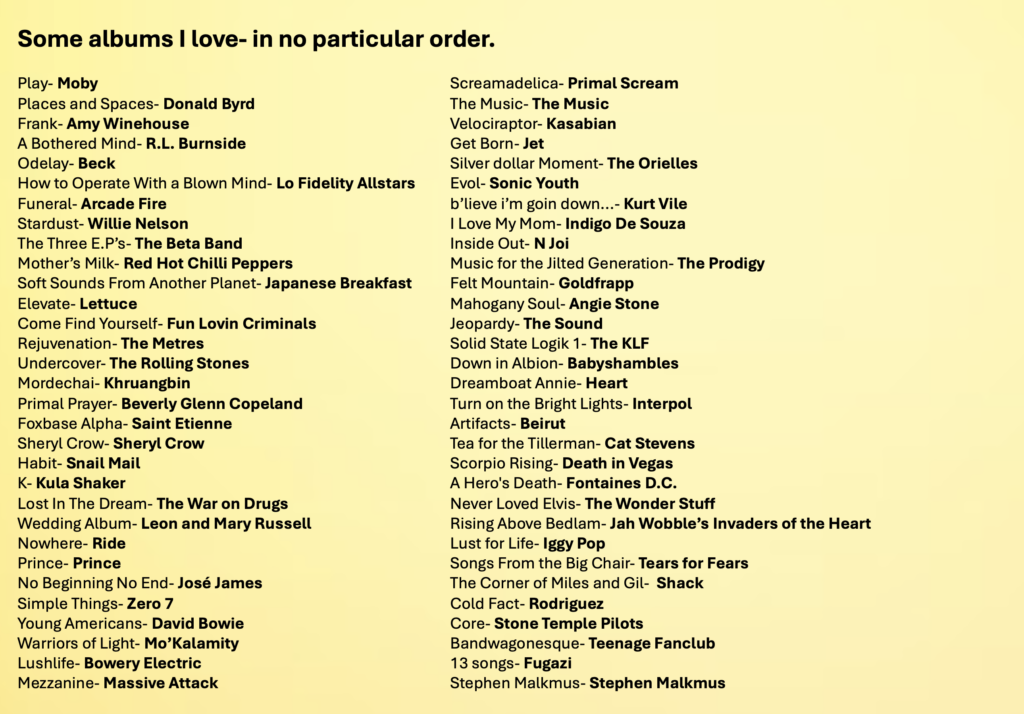
I have attached a list of random albums I love that sprung to mind. Feel free to listen and discuss them with me or even send me a few; that would be a right treat. I have also attached a link to Every Noise, a site to browse that has quite literally every genre laid out for you to explore. Find the genre you love and explore around it. Trust.
https://everynoise.com – give it a minute to load, there’s a lot…