VIRAL IS THE BIGGEST LIE IN MEDIA RIGHT NOW. I’VE BEEN TESTING IT.
Make the post. Tap into the algorithm the exact right way. Wait for the views to skyrocket. Become famous and relevant overnight. Viral is the golden ticket. Millions of creators do this every single day. I’ve noticed people lifting the exact opinion‑piece model I’ve been using since day one and other great things my friends are doing. I didn’t invent the opinion post, no, but I’ll def claim my tone, voice and saying fuck the most. The truth is the second something ‘proves’ itself online (deliberate or not), everyone rushes to photocopy it. That’s the ecosystem, imitation as strategy, replication as currency.
Copying is what happens when attention collapses. Original thought requires a brain and conditions we no longer have. The cognitive environment is degraded.
They see these posts hitting numbers, so they try to copy the tone, the honest-rant energy, everything. They copy on autopilot, like they always do. With integrity gone and shame irrelevant, they laugh it off, unaware it only highlights the absence of thought or intelligence behind it. But here’s the hilarious part, I know I’m playing the game. They’re just desperate for attention, chasing the same hollow virality the Northern Exposure piece just privately roasted. I’ve been writing like this for over 15 years, back when I contributed to other magazines and took all the heat for it. I’ve posted these raw opinions online only to get obliterated by trolls, back when I was lucky to pull two or three likes.
See over the past month, I’ve deliberately run some cold-blooded experiments. Nothing like a proper PhD study with real data, just a handful of small tweaks to titles, posting times, formats, and platforms. It’s not to say I couldn’t conduct proper surveys, I’m not naïve. I know exactly what ‘real’ journalists write and what’s expected, but Northern Exposure has never been about colouring inside the lines and it never will be. I’d rather eat beans off a stick than sell my soul for sponsorship or clout. I’ve got the qualifications, but I’m a punk at heart, I’m not here to perform obedience or do as I’m told. I’m human too and guess what? Like all of us, sometimes I get shit wrong. My main reason was trying to crack the psychology of what was supposed to be “the thing right now,” and I stumbled on a harsh, uncomfortable truth about all of it.
The uncomfortable truth
Something that should piss everyone off: Viral is the biggest scam in media right now. Despite collectively over 3 million views on Instagram this last few weeks from my personal account and Northern Exposure, the website views didn’t tell the same story. Up but nowhere near these figures. Don’t get me wrong it’s flattering that people liked and shared my words, well, some of them. But it’s the article I want people to look at not just like the instagram post. Do you get what I’m saying? That’s where the time and effort went, the whole point of testing this was to see if the Instagram hook, lead to actual reads. It’s set up so you don’t leave social media, I know getting to links is made hard.
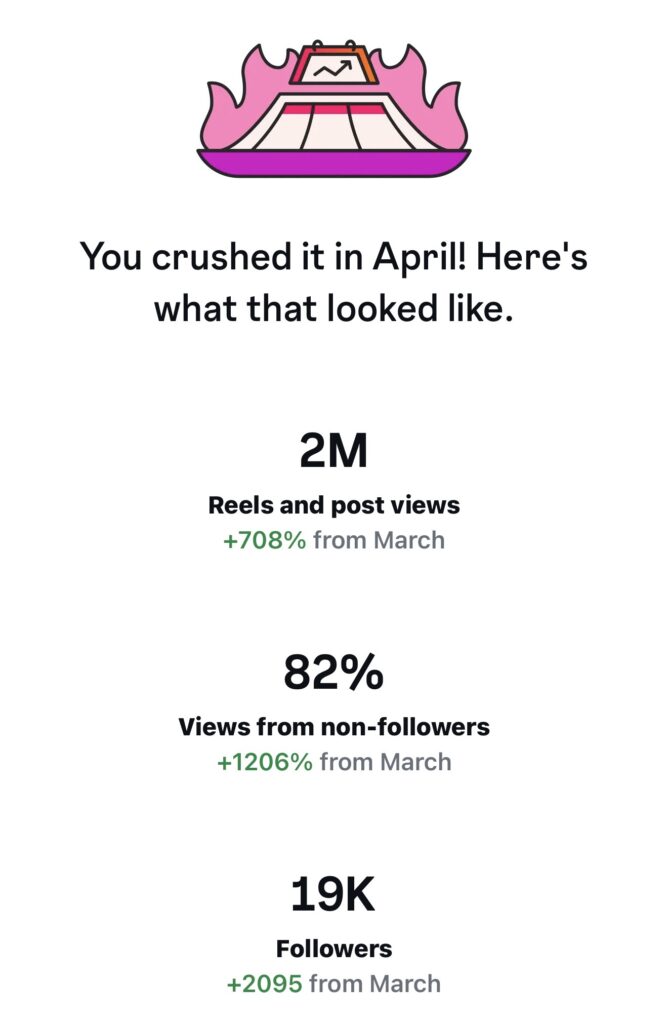
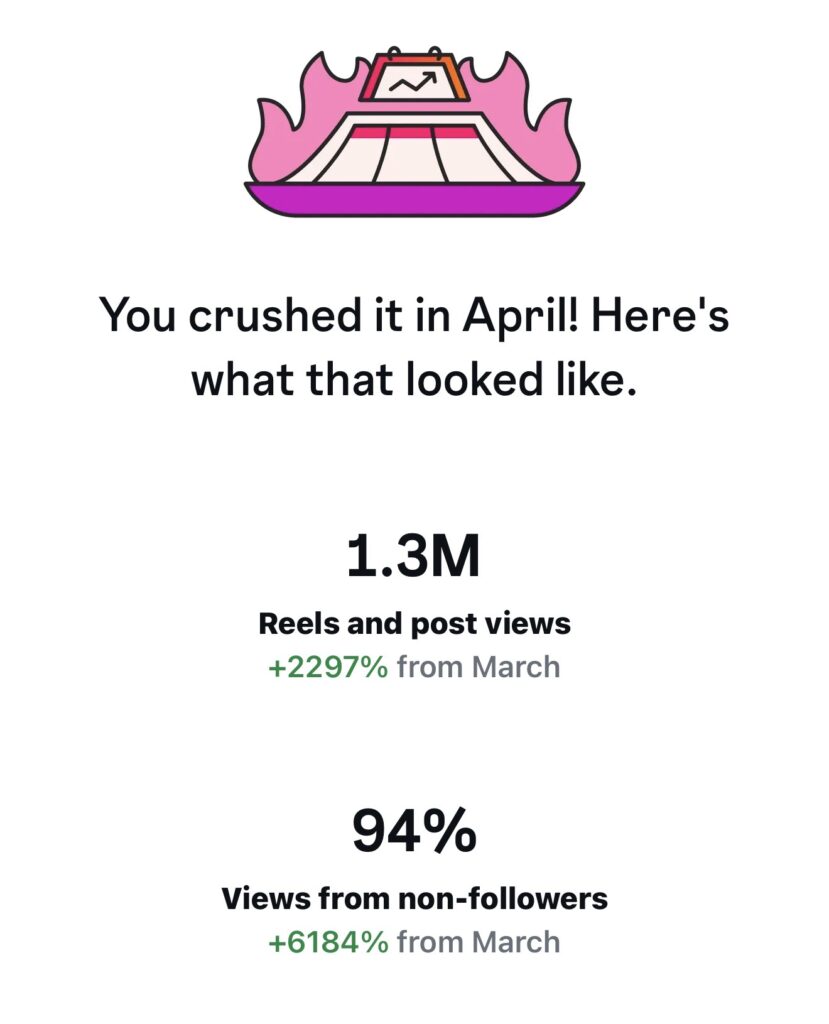
So what’s going on? There’s nothing wrong with becoming a viral star, per se. The issue is that this term became a myth used to enslave creatives, make them paranoid and produce unlimited content, as if the algorithm would somehow crown someone talented or truthful. Viral is more about noise, lucky timing, and the lack of options, but most people were made to believe that their inability to hit the mark means that they’re doing something wrong.
It’s a grind, and the “go viral or die” pressure is exhausting and mostly illusory.
Because the truth is that it’s not about being viral. It’s about what happens (or doesn’t) when you break free from that lie.
The attention crisis is real
I watched The Devil Wears Prada 2 last night. Well, I know why you’re thinking, it wasn’t for the fact that I’m a die-hard fan of Miranda Priestly and her blue outfit (alright, alright, there might be a tiny bit of that in me, but really, Emily from Paris stole me away…). In all honesty, it touched upon all this and it’s the morning after the movie’s premiere that I wish to discuss now. The carousel of breaking down every single outfit, the think piece of 15 seconds worth of commentary. It is like everyone is commenting on the commentary, and no one is reading the real reviews anymore.
We have reached our cultural apocalypse, and nobody cares.
But it should not really come as a surprise. Let’s put this in numbers. According to Gloria Mark at UC Irvine (in her 2023 book Attention Span), back in 2004, the average sustained attention on a computer screen was 150 seconds. By 2012, it had fallen to 75, and right now it is around 47 seconds. This is a sad state, especially with short-form videos making it worse. Research shows that heavy short-form video use is linked to weaker sustained attention and poorer task performance. Forty per cent of British adults have stopped reading books for leisure, and the children’s rate is the lowest ever in history.
We did not lose the ability to concentrate. We just stopped caring because whatever we read doesn’t give us that dopamine boost every three swipes.
Why platforms reward swipes, not substance
When printed media started failing, and everyone shouted “Digital is the future,” the platforms changed their algorithms. Today, they no longer reward depth, they reward engagement. Carousels mean multiple attempts from the user and better algorithm metrics. I’ve been testing it. Ten images with album covers and short descriptions count as ten engagements. Reels are even stronger. Data for 2025-2026 shows carousels getting 12% higher engagement rates than reels on Instagram, sometimes up to 114% better than a single picture post. Brands chase the big numbers: “Look at our 2.5 million impressions!”
But these metrics mean almost nothing. Impressions are easy. They don’t require real attention, just swipe and move on.
What the testing actually showed
We at Northern Exposure know exactly how much of this nonsense there is. This month, some of our posts/website was viewed by over four million people. Viral? Sure, if you count swipes which account for over 3 million of them. Yes, our web traffic went up, but nowhere near matching those views. Actual article reads are a fraction of that. People saw the pieces and the photos and kept scrolling. You know that’s gutting when you put a lot of time and effort into a write-up.
Most mornings, I’m up and down to one of my favourite cafes for a flat white and a croissant. Writing notes, typing and editing like a mad woman to get my thoughts down, just like I am right now. I write from the café table, not the ivory tower. I’m not theorising about media collapse, oh no, we’re experiencing it in real time, watching the numbers lie to our faces.

It’s nice when you see the 25k likes on my words, but what does it mean, really? Have they read it all? Have they contemplated what I’m saying in more depth?
Probably not..
The NME went fully digital, and engagement time fell by 72%. Reach went up, but people treat social as discovery and rarely click through.
II’ve mentioned many times before how much I miss real music magazines. The ones you grabbed on a Friday and read cover to cover. The authors spent months with artists, digging into the politics and the heartbreak in the songs, without chasing likes. Those publications connected you to the scene, exactly what I wrote about in my piece on the collapse of music print media. Now every journalist is making “content”, and the classics are disappearing.
Some of the best, most respected music journalists, the ones who lived through the eras and built real relationships, aren’t desperate to learn new dashboard tricks. They’ve earned their place. Forcing them into the new rhythm risks losing exactly the voices we need most.
The algorithm didn’t just kill the newsstand. It killed the stories and the people that made us care.
This is how social media killed media. There is literally zero reason for someone to click through when they can get it all in the feed. But we still play the game and post carousels and reels. “10 pictures from the gig!” “Swipe for the drama!”
The Devil Wears Prada 2 works great as an analogy for the chaos we’re in. And our reaction? More carousels. More costume breakdowns. A movie review? Forget it, you’ll get five slides and a link in bio no one will ever click.
What everyone knows but doesn’t say is that the death of print didn’t kill journalism. Obsessing over meaningless numbers did.
We conditioned readers to think anything worth reading fits in a few slides. Then we wonder why no one finishes the long piece on dying venues or dynamic pricing https://northernexposuremagazine.co.uk/dynamic. I have tested this recently, and it confirmed everything I’m saying. The clicks do come, the more savage the better. Does it align with the reads on articles? Unfortunately, not.
This doesn’t mean we should stop making carousels and reels. They should exist. But they are not the same as real engagement or people actually reading the write-up. We can scream about 2.5 million impressions, but the ones who actually read are in the thousands. Still, at Northern Exposure, we keep publishing the long music articles that matter.
The algorithm doesn’t love us. It loves our attention. And right now it’s winning.
To everyone still reading this, congrats. You’re part of the statistical anomaly. To those still scrolling down, my best wishes.
At times, it seems like we are repeating ourselves, but it really does feel like everything is coming to an end. The tangible magazines, the slow interviews, the real connection to not only music but any writing. We don’t want to let it go, and there’s a good reason why.
We cannot revive what is already dead. So what can we do?
Certainly, others would tell you that the funnel does work; after all, a handful of writers can make a living out of their impressions and dopamine hits. Their adaptations might even be ingenious when viewed from an abstract point of view. But there’s the thing that really counts: it’s all social media; nothing of it involves actual reading. Swipe, like, engage, move on. Impressions flood in; the algorithm gives you a pat on the back; the entire article remains unseen. The figures lie because, by design, the platform keeps viewers glued to its newsfeed and not clicking away to your website for a proper reading. I’d rather have people read my articles to be honest. I’ve little interest especially this days to spend more time on Instagram than I have to, never mind come up with an endless stream of content. Fuck that.
In today’s attention economy, substance is the new black. And as usual, darling, it’s out of fashion.
I walked out of the theatre worried about the future. People keep chasing viral like it’s a ladder out of obscurity. It isn’t. It’s a treadmill built to exhaust you while the platforms skim the sweat. Once you see that, you stop running and you start writing for people who can actually read.
Sources
1. Gloria Mark attention span data (150 seconds in 2004, 75 seconds in 2012, ~47 seconds today) – Gloria Mark’s own summary of her long-term research and her 2023 book Attention Span: https://gloriamark.com/attention-span/
2. Research on heavy short-form video use being linked to weaker sustained attention and poorer task performance – Multiple peer-reviewed studies, including a 2024 EEG study on mobile short-video addiction and executive control: https://pmc.ncbi.nlm.nih.gov/articles/PMC11236742/
(See also the 2025 systematic review in Psychological Bulletinfor a broader overview.)
3. Forty per cent of British adults have stopped reading books for leisure – YouGov poll, March 2025: https://yougov.com/en-gb/articles/51730-40-of-britons-havent-read-a-single-book-in-the-last-12-months
4. NME engagement time fell by 72% after going fully digital – Academic case study published in Journalism Practice, 2020 (updated audience data analysis): https://www.tandfonline.com/doi/full/10.1080/17512786.2019.1685903
5. 2025-2026 Instagram carousel data (12% higher engagement than Reels, up to 114% better than single-image posts) – Buffer’s analysis of millions of posts, early 2026: https://storrito.com/resources/how-instagram-carousels-beat-reels-for-engagement-in-2026-and-when-to-use-each/ (citing Buffer’s State of Social Media report).