
Recently, I saw Adéla at Leeds Festival and was blown away. I knew she was someone people would be talking about a lot. She may only have one breakthrough single, “Ain’t In LA”, but her performance was one of the best performances from a new artist that I’ve seen in years. Her talent and vibe on stage felt remarkably assured for an artist so early in her career. The ballet-infused choreography was something I wasn’t expecting in an already captivating performance, and I just couldn’t take my eyes off her. She was a gift for us photographers.
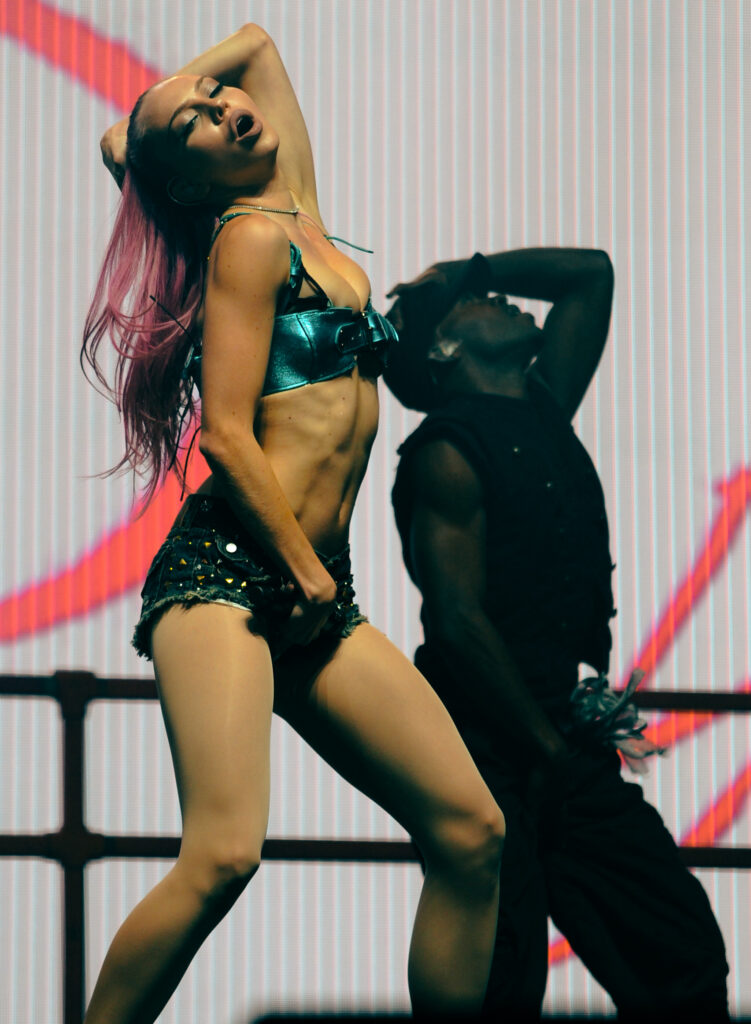
Being the sort of person who’s never really cared much about pop music in general, seeing Adéla and Charli XCX literally flipped my perspective. Watching Charli continue to champion young women artists has made that commitment even stronger.
What I saw at Leeds was only part of a bigger picture of Charli actively championing young women artists. Over the past week, Charli XCX has been publicly championing Adéla more broadly, sharing her with the kind of audience most emerging artists can only dream of reaching. This is part of what Charli XCX is known for: using her success to boost new artists, even if it doesn’t always define how the wider public sees her.
She has a track record of it now, with Addison Rae and Adéla being just two recent examples. It didn’t happen overnight, either. Remember when everyone thought “Girl, so confusing” meant some quiet little feud was brewing between Lorde and Charli? So what did they do? Sorted it out with the remix. Lorde offered up the idea herself after receiving a voicemail from Charli. They sang about the insecurities and pressures in the industry they’d been dealing with for ages, making it messy and raw rather than feeding whatever tired old narrative they might otherwise have been told to follow. That honestly feels really important in an industry where it’s sadly commonplace for women to see each other as competition.
While Charli continues to carve out space within pop music, what I’ve witnessed her doing throughout her career is making more space possible for others alongside her, even if that influence doesn’t always land evenly or without debate. She publicly backed Addison Rae, featuring her on a track and defending her when critics dismissed her music as a vanity project. Addison has gone ahead and referred to Charli as her big sister and mentor, the first one ever to give her confidence enough to take her thoughts seriously, while Charli called her a fucking genius herself. The interaction went beyond any singular feature piece or one-off Instagram story. This matters contextually in ways standard industry pleasantries simply don’t.
What elevates these moments above lip service is that Charli XCX has experienced years of waiting for cultural recognition of her contribution. She’s been developing her music career since before her early success, writing hits for artists like Iggy Azalea and Selena Gomez while pushing pop in a more experimental direction through her own work. The emergence of Brat appeared rapid only to anyone who hadn’t followed her years of genre-pushing, risk-taking work that had been quietly building towards exactly that moment.
To anyone who’s tracked her history, it was the breakthrough of years spent experimenting, taking risks and persevering through frustration. That history probably explains why she seems so comfortable sharing her stage and boosting emerging female musicians. Having invested so much in establishing her own credentials, she understands that artistic success isn’t instantaneous and that recognition and merit don’t always align perfectly. She’s lived it herself and knows how game-changing a public endorsement can be for an emerging artist.
It’s an attitude that sees potential as inspiration rather than a competitive threat, and honestly, that’s fucking refreshing and essential.
Perhaps that’s the main reason it resonates so strongly with me. I’ve always believed in championing other women whenever possible, much to my own detriment a lot of the time. Whether that’s been sharing their work or celebrating their achievements. I do my best to create opportunities where I can. I’ve seen how much can change when people choose collaboration over competition, and the support Charli extends to emerging artists feels like a larger expression of that same principle.
But there’s another aspect to this, one I find difficult to ignore. Society likes the idea of strong women far more than it often likes the reality of them. Ambition, conviction and self-belief are frequently celebrated in the abstract, yet women who embody those qualities can still find themselves labelled difficult, intimidating, arrogant or divisive. We continue to live with cultural narratives that reward women for being accommodating but become noticeably less comfortable when women are unapologetic about their talent, influence or authority.
Perhaps that is why examples of women actively supporting one another continue to matter so much. They challenge the assumption that power is a scarce resource and that success belongs only to whoever reaches the top first. Women like Charli XCX are not only creating space for themselves; by actively championing other women rather than treating success as a competition, they demonstrate that confidence and generosity can coexist, and that strength does not have to come at another woman’s expense.
The example she sets, choosing generosity over rivalry, is worth paying attention to.
Women are still so often pitted against each other by popular culture, framed as rivals competing for the same chart position or fanbase, and judged relative to one another in ways that rarely apply to male artists, even if that is slowly beginning to change. Narratives of rivalry are convenient and simplistic, but it takes a certain generosity of spirit to accept narratives of cooperation and mentorship in their place.
Yet increasingly, Charli XCX offers precisely this alternative story: cooperation over rivalry rather than the convenient narrative of competition. In highlighting the importance of Adéla’s music, she shows what success looks like when you don’t view other people’s achievements as a threat and instead choose to extend genuine influence.
It doesn’t come across as performative, and its consistency, appearing repeatedly rather than as a one-time gesture, is what makes it feel genuine. Rather than a one-off act of goodwill, it feels like a genuine part of how Charli approaches success and influence within pop music.
And honestly, that willingness to reach back and bring others through the door with her might matter just as much to pop music as anything she has made herself, because it shapes who gets to make the music at all.
After investing so heavily in herself to gain access, she isn’t raising the drawbridge behind her. Instead, she continues reaching back, creating opportunities and demonstrating that truly confident artists don’t fear other talented women succeeding alongside them.
I noticed the same instinct during the latest leg of the tour too, instead of hogging the spotlight solo, she gave whole performances to Chappell Roan, PinkPantheress and Adéla at the LA gigs. It remains remarkably rare for artists in positions such as hers to accord that kind of respect to other people’s hit records.
We all need more of this, please.
About the Author